Hernando Joaquín de Tristero y Calavera and Jan Hinckart’s rivalry
The Crying of Lot 49Hernando Joaquín de Tristero y Calavera and Jan Hinckart’s rivalry grows out of a contested claim to the lordship of Ohain and the Grand Mastership of the Post. Set against the upheaval in the Low Countries, it moves from a disputed family connection to a guerrilla campaign and, as the Thurn and Taxis monopoly weakens, to the creation of a rival clandestine postal system.
Political and dynastic background
In 1577, after nine years of struggle by the northern Low Countries for independence from Catholic Spain and the Holy Roman Emperor, William of Orange entered Brussels in triumph. A Committee of Eighteen, a Calvinist junta that believed the Estates-General no longer represented skilled workers, established a kind of Brussels Commune. It controlled the police, dictated the Estates-General’s decisions, and removed many officeholders.
Among those displaced was Leonard I, Baron of Taxis, hereditary Grand Master of the Post for the Low Countries and executor of the Thurn and Taxis monopoly. Orange’s loyal adherent Jan Hinckart, Lord of Ohain, took his place. That political appointment became the center of Tristero’s challenge: he claimed to be Hinckart’s cousin from the Spanish, legitimate branch of the family, and the true lord of Ohain, with a rightful claim to Hinckart’s possessions, including the postal office.
From inheritance claim to armed opposition
Tristero’s standing is uncertain even in the account Oedipa reconstructs: he may have been a madman, an honest rebel, or, in some people’s view, a con artist. The rivalry therefore rests not on an established kinship but on competing assertions of family legitimacy and political right. Tristero styled himself El Desheredado, or the Disinherited, making dispossession the recurring language through which he presented his cause.
From 1578 until Alexander Farnese retook Brussels for the Emperor in March 1585, Tristero waged what amounted to guerrilla war against Hinckart—if the two were indeed cousins. His Spanish identity brought him little support, and his life was often in danger. He tried four times to assassinate Orange’s postmaster, without success. The attempts underscore the gap between his claim to authority and his inability to secure it through either political allegiance or direct action.
The rivalry expands into a postal insurgency
When Farnese took Brussels, Hinckart was dispossessed and Leonard I was restored as Grand Master. Yet the restoration did not simply settle the contest. The Thurn and Taxis monopoly itself was unstable: Emperor Rudolph II temporarily withdrew patronage because he distrusted the Bohemian branch’s strong Protestant leanings, and the postal operation fell deeply into debt.
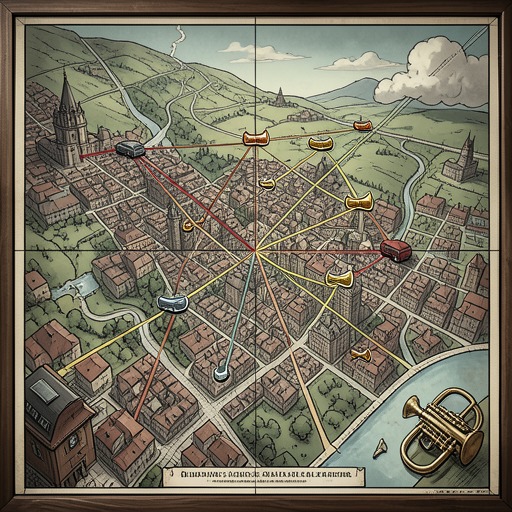
The weakening of the monopoly may have suggested to Tristero the larger power structure Hinckart might have controlled. Tristero then appears to have established a system of his own and organized covert obstruction, terror, and depredation along the Thurn and Taxis mail routes. The conflict thus exceeds a feud over inherited status: the disputed office is the gateway to a contest over control of communications and the institution that carries them.
Symbols and the account’s uncertainty
Tristero’s followers wore black, which he said represented the night—the only thing that truly belonged to them in exile. He added a muted post horn and a dead badger with its feet in the air to the movement’s imagery. The badger also invited an uncertain explanation: some connected the name Taxis to the Italian word tasso, or badger, and to the badger-fur hats worn by early Bergamascan couriers. The symbols turn dispossession into a shared identity while fastening the rebellion to the postal world it opposes.
The history reaches Oedipa through fragments rather than a single authoritative record: material gathered by Diocletian Blobb, obscure philatelic journals from Genghis Cohen, a footnote in Motley’s Rise of the Dutch Republic, an old pamphlet on anarchism, and sermons by Blobb’s brother Augustine among Emory Bortz’s Wharfingeriana. Its repeated qualifications leave Tristero’s kinship, character, and precise motives unresolved. That uncertainty does not erase the rivalry’s consequences; it makes the account itself resemble the clandestine conflict, assembled from scattered traces whose claims cannot be fully verified.